How to play
Lost Ruins Of Arnak
The short answer
Lost Ruins of Arnak combines deck-building with worker placement over five rounds — you play cards to travel to dig sites, discover new ones, overcome the guardians you wake, and climb the research track, and the most points after round five wins.
- Players
- 1–4
- Play time
- 120 min
- Age
- 12+
- Complexity
- Medium2.9/5
Last updated · Written and filmed by Boxman 3000

Watch on YouTube — plays here count toward the channel too.
Lost Ruins of Arnak is a deck-builder wearing a worker-placement coat. Your cards are not just money — their travel value is what carries an archaeologist to a dig site. Spend them well and you uncover idols, wake guardians, and climb the research track.
The game lasts five rounds. Most points wins.
Setup
Use the bird temple side of the board for your first game; the snake temple is the advanced version.
- Place the moon staff at the first position. Shuffle the artifact and item decks, then deal 1 artifact to the left of the moon staff and 5 items to the right.
- Put the fear cards out.
- Place 1 idol tile face up on each level 1 dig site, and 2 idol tiles — one face up, one face down — on each level 2 dig site.
- Block spaces by player count:
| Players | Blocking |
|---|---|
| 2 | Block all double-boot spaces |
| 3 | Block 3 random double-boot spaces |
| 4 | Use every space |
- Stack the temple tiles. Randomly stack as many research bonus tiles as there are players, face down at the top of the track, then place the remaining bonus tiles face up in their spots. Some spaces are for 3–4 player games only.
- Put out the resources. Shuffle the level 1 and level 2 dig site tiles and the guardian tiles. Shuffle and place three stacks of assistants, silver side up.
- Each player puts their notebook and magnifying glass at the start of the research track, takes a player board and their starting cards — two Funding, two Exploration and two Fear — shuffled face down, and places their archaeologist meeples on their board.
The starting player is whoever most recently visited somewhere they had never been. Distribute starting resources by turn order.
How a Turn Works
On your turn you take exactly one main action, plus any number of free actions.
| Main actions |
|---|
| Dig at a site |
| Discover a new site |
| Overcome a guardian |
| Buy a card |
| Play a card |
| Research |
| Pass |
Your hand
Every card has a travel value used for digging, and an effect. If the effect has a lightning bolt beside it, it is a free action and does not consume your main action.
Fear cards have no effect at all. They do carry a travel value, so they are not useless — but they are negative points at the end of the game. Exile them whenever you get the chance.
Dig at a site
The main way to gain resources. You need an empty space at the site and an available archaeologist.
Pay the travel cost by placing cards from your hand into your play area. Then place an archaeologist and resolve the site’s effect.
Travel symbols are flexible:
| Symbol | Pays for |
|---|---|
| Airplane | Any other icon |
| Buggy or ship | A boot |
| 2 coins | Charters a plane |
Discover a new site
Pay 3 compasses for a level 1 site or 6 for a level 2 site, then place an available archaeologist there. In order:
- Resolve the face-up idol and place it face down on your player board. Sites with two idols only resolve the face-up one.
- Take the top tile from the matching stack, place it face up at that location and immediately resolve its effect.
- Awaken a guardian — place the top guardian tile face up on that location.
The guardian does nothing straight away. But if that guardian and your archaeologist are both still there at the end of the round, you gain a fear card.
Overcome a guardian
With an archaeologist already at a guardian’s site, pay the guardian’s cost to overcome it and place it beside your player board.
Each guardian has a boon in its top right, usable once on any of your turns — flip it over after use. Every guardian is worth 5 points at the end of the game whether you used its boon or not.
Guardians sit at dig sites until overcome, but they do not stop you digging there.
Buy a card
- Item cards: pay the cost at the bottom left and place the card face down at the bottom of your deck.
- Artifacts: pay the compass cost at the bottom, then move it straight to your play area and resolve its effect without paying the activation cost.
Then refill the row by sliding the cards toward the moon staff and adding a new card from the deck to the empty space.
Play a card
Place it face up in your play area and resolve its effect. A lightning bolt makes it free; otherwise it uses your main action. Playing an artifact from your hand requires paying its tablet cost first.
Research
Choose either your magnifying glass or your notebook, pay the cost printed between it and the space you want, and move it there.
The notebook can never move ahead of the magnifying glass.
If there is a bonus tile on that space, resolve it and remove it from the game — these are strictly first come, first served. Then gain the row effect for the token you moved:
- Silver assistant icon: take a face-up assistant and place it on your board, silver side up.
- Gold assistant icon: flip one of your assistants to its gold side.
You may resolve the row effect before the bonus tile if you prefer.
The purple points on the track are not cumulative — they show the value your magnifying glass and notebook are worth where they currently sit.
Reaching the Lost Temple. When your magnifying glass arrives, place it in the leftmost empty space and take a bonus tile, resolve it and remove it. From then on, choosing research lets you activate your magnifying glass to pay for any temple tile and add it to your board for end-game points.
Pass
If you cannot or do not want to take another main action, pass. Once you pass you can take no further actions at all — so resolve every free action you want before passing.
Idols, Assistants and Exile
Idols
Idols come from discovering sites and sit face down on your board, each worth 3 points.
As a free action you may permanently place an idol in the leftmost open slot on your board to resolve one of the effects printed there — handy when every site giving the resource you need is occupied.
The trade-off: uncovered idol slots are worth points on their own, and covering one loses those points. The idol itself is worth 3 points either way.
Assistants
Recruit assistants by moving your notebook up the research track. Choose a face-up tile from one of the three stacks and place it on a free spot on your board.
Exhaust an assistant to use its effect; it cannot be used again until next round unless something refreshes it. Upgrading an assistant flips it to its gold side and refreshes it automatically, even if the silver side was already exhausted.
Exile
Some effects exile cards, meaning they go to the matching discard pile beside the deck rather than back to yours. Fear cards go on top of the fear deck.
End of Round
After rounds 1 to 4:
- Return all archaeologists to your board. If one was at a site with a guardian, add a fear card to your play area.
- Any cards still in hand may either be added to your play area or kept for next round.
- Shuffle everything in your play area and place it at the bottom of your deck.
- Refresh your assistants.
- Exile the artifact and item beside the moon staff, move the moon staff one space right, and refill the card row.
- Pass the start player marker to the left.
After round 5, take back your archaeologists and gain any guardian fear cards, then skip the rest and go straight to scoring.
How to Win
Score up:
- The value of each research token where it sits
- Temple tiles
- Idols (3 each) and uncovered idol slots
- Guardians overcome (5 each)
- Items and artifacts
- Minus points for fear cards
Most points wins. Ties go to whoever reached the temple first; if nobody did, to the player furthest along the research track.
Snake Temple (Advanced)
The reverse of the board has different travel costs on the dig sites and a different research track. The headline addition is the assistant rescue spot — one per player — where you discard an idol from your supply to move your magnifying glass up, search the assistant stack, and place your choice on your board exhausted. Idols already placed in an idol slot cannot be discarded this way.
It also adds magnifying glass effects that hand you a fear card, and a row of first-come-first-served bonus tiles.
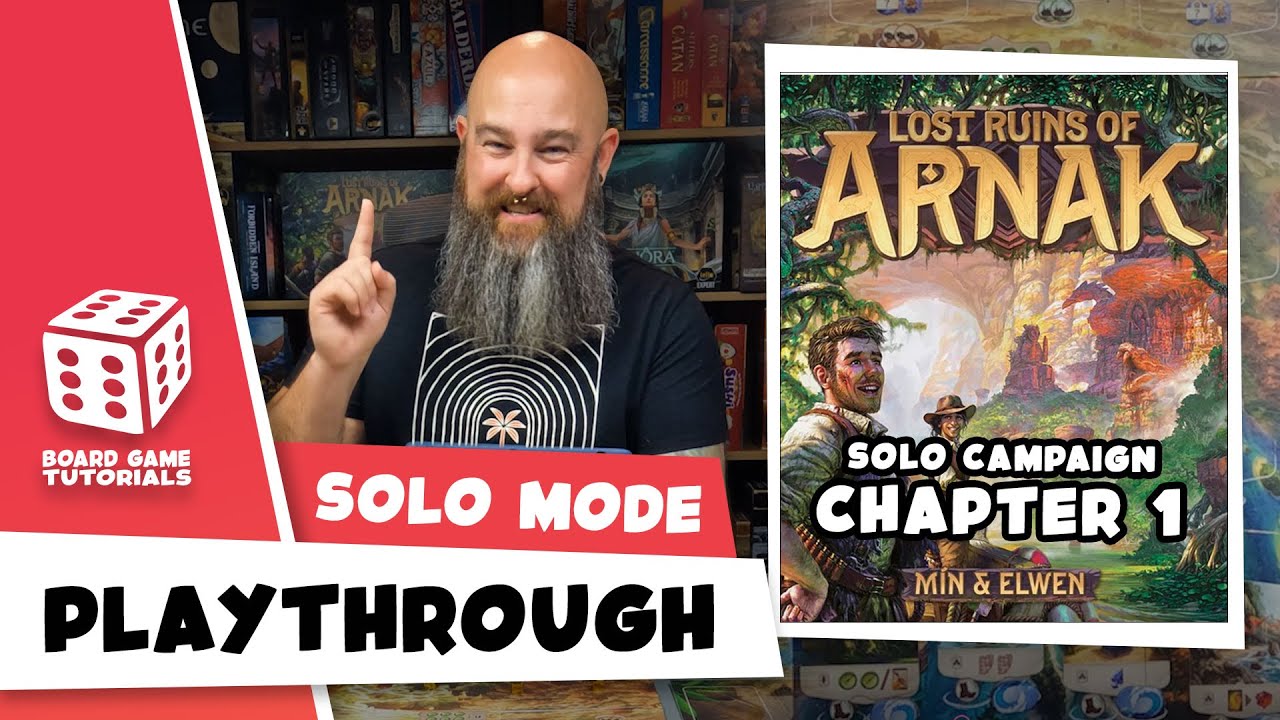
Solo Mode
You play against an automated rival driven by a stack of action tiles; a companion web app builds the stack and handles campaign play.
Set up a two-player game and give yourself a gold and a compass, since you go second. The rival takes a player board grey side up and all six remaining archaeologists, uses only the magnifying glass (keep the notebook in the box), and is always the start player.
Each turn, reveal and resolve a rival action tile, then take your own turn. The rival does not pass until every action tile has been played.
The rival’s actions block you rather than build an engine: it digs the topmost site with a matching resource, discovers sites appropriate to the round (doing nothing on round 5), advances its magnifying glass, overcomes guardians at sites it occupies, and buys the highest or lowest value card as its arrow dictates. A decision arrow breaks all ties.
At end of round the rival returns its archaeologists but never gains fear cards.
The rival scores for its magnifying glass position, temple tiles, guardians overcome and cards purchased, plus 3 points per unique face-up idol and 2 points for each idol in its negative stack. Score yourself normally and compare.
Common Mistakes
- Passing with free actions unused. Once you pass you are done for the round — no free actions, no card effects, nothing.
- Leaving an archaeologist with a guardian. If both are still there at end of round, that is a fear card.
- Moving the notebook past the magnifying glass. It can never overtake.
- Paying an artifact’s activation cost when buying it. Buying an artifact resolves it for free; only playing one from hand costs tablets.
- Covering idol slots carelessly. You lose the printed points of any slot you cover, and only you can judge whether the effect is worth it.
- Treating research points as cumulative. Your score is where the tokens end up, not the sum of everything you passed.
- Forgetting guardians do not block digging. You can work a site you cannot yet defeat.
Frequently asked questions
- How long is a game of Lost Ruins of Arnak?
- Five rounds, roughly 30 minutes per player. Each round every player takes turns until they choose to pass, and once you pass you cannot act again that round.
- How do you get fear cards in Arnak, and what do they do?
- Fear cards have no effect but still carry a travel value, and they count as negative points at the end of the game. You gain one if an archaeologist ends the round at a site with an unresolved guardian, and from various card effects. Exile them whenever you can.
- What happens when you discover a new site?
- Pay three compasses for a level one site or six for a level two site, place an archaeologist, resolve the face-up idol and take it, place and resolve the new site tile, and then awaken a guardian at that location.
- Do guardians stop you digging at a site?
- No. A guardian sits at a site until someone overcomes it, but you can still dig there. The risk is that leaving your archaeologist there at the end of the round earns you a fear card.
- Are guardians worth points if you never use their boon?
- Yes. Every guardian you overcome is worth five points at the end of the game whether or not you used its once-per-game boon.
- Can the notebook move ahead of the magnifying glass?
- Never. The notebook may catch up to the magnifying glass but can never pass it, which is what forces you to advance both rather than racing one up the track.
- Should you place idols in the slots on your player board?
- It is a genuine trade-off. Placing an idol resolves a useful effect, but the slot you cover has printed points you then lose. The idol itself is worth three points whether it sits in a slot or not.
- What is the difference between the bird temple and snake temple boards?
- The snake temple is the advanced side, with different dig site travel costs and a different research track. Its main new feature is the assistant rescue spot, where you discard an idol from your supply to search the assistant stack and take one exhausted.