How to play
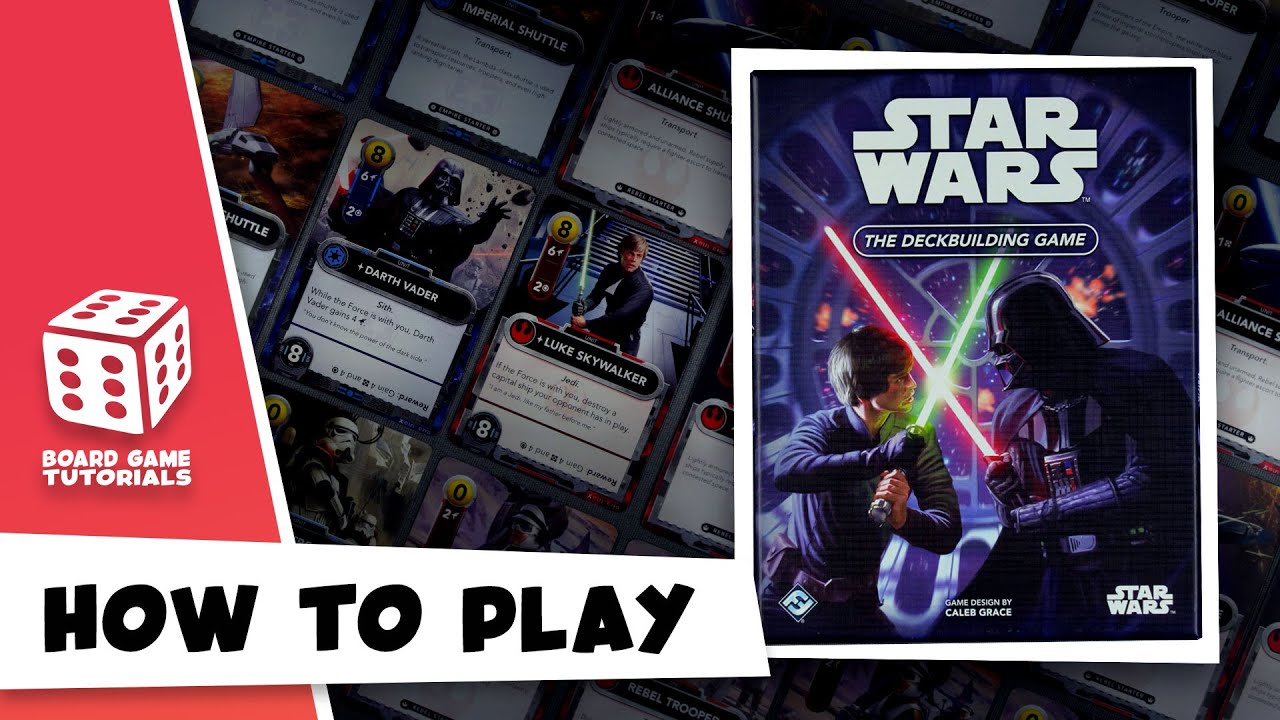
Star Wars: The Deckbuilding Game
The short answer
Star Wars: The Deckbuilding Game is a head-to-head duel between the Empire and the Rebellion where you buy cards from a shared galaxy row to build an attacking deck — and you win by destroying your opponent's bases.
- Players
- 2
- Play time
- 90 min
- Age
- 12+
- Complexity
- Light–Medium2.0/5
Last updated · Written and filmed by Boxman 3000
Watch on YouTube — plays here count toward the channel too.
Star Wars: The Deckbuilding Game is strictly two players, Empire against Rebellion. Both sides buy from the same galaxy row, but each can only take neutral cards or cards of their own faction — so the row is as much about denying your opponent as arming yourself.
You win by destroying your opponent’s bases.
Setup
- For your first game, each faction uses the five recommended bases listed in the rulebook; return the rest to the box. Experienced players should use Full Galaxy mode instead (see below).
- Place your starter base face up, with the rest face down underneath it.
- Shuffle your 10 starter cards and place them face down as your deck.
- Shuffle the 90 galaxy cards and deal 6 face up in a row in the middle, orienting Empire and Rebel cards toward their respective players. This is the galaxy row.
- Place the 10 Outer Rim Pilot cards at the other end of the row.
- Put out the damage and resource counters.
- Unfold the balance of the force track and set the force marker all the way to the Rebel side.
- Each player draws 5 cards.
The Balance of the Force
The force track measures who currently has the upper hand, and it does two things.
Abilities that say “if the force is with you” only work while the force marker sits on one of the three spaces on your side of the track. Gaining force moves the marker toward you.
If the marker is all the way on your side at the start of your turn, you gain an extra resource for that turn.
If the marker sits in the neutral middle, nobody benefits.
Reading the Cards
| Card type | Shows |
|---|---|
| Unit | Resource cost, attack damage, resources generated, force generated, title, unique symbol, traits, ability, the attack value needed to defeat it in the galaxy row, and the reward for doing so |
| Base | Faction, unique symbol, name, ability and hit points |
| Capital ship | Resource cost, attack damage, resources generated, name and hit points |
Both factions have their own characters, vehicles and bases, plus neutral cards that either side may buy.
How a Turn Works
The Empire takes the first turn, then the Rebels.
Beginning of your turn
- If your base was destroyed, select a new base.
- Gain a resource if the force is fully on your side.
- Collect resources from every capital ship you have in play.
During your turn
Do any or all of the following, in any order, as many times as you can:
Play a card. Place it face up in front of you, collect any resources it provides, and advance the force track if it has a force value. Units are discarded at end of turn; capital ships stay in play.
Purchase a card. Choose a neutral card or one of your own faction from the galaxy row, pay its resource cost, and put it in your discard pile unless a card says otherwise. Immediately refill the row from the galaxy deck.
Use a card ability. Once a card is in play you may activate its ability once per turn. Resolve as much as you can and ignore the rest, then tilt the card to show it has been used. A tilted card can still attack later if it has an attack value.
Commit to an attack. Group the cards you are committing and place them in front of your target, keeping each card’s orientation so you can still see which abilities have been used. Each card may commit to one attack per turn.
Resolving an attack on a base
Total the attack value of your committed units and capital ships, take that many damage counters, and apply them in this order:
- Destroy all your opponent’s capital ships first, distributing damage as you like.
- Apply any remaining damage to their base.
When damage on a base equals or exceeds its hit points, that base is destroyed and placed at your end of the force track. Excess damage is returned to the supply — your opponent will not choose a replacement base until the start of their next turn, so there is nothing to spill onto.
Keep the attacking cards grouped as a reminder that they cannot attack again this turn.
Bounty hunting and sabotage
These are the same action under two names — bounty hunting for the Empire, sabotage for the Rebels. You attack a card sitting in the galaxy row to remove it and claim a reward.
Target a card of the opposing faction and total the attack value of your committed units — capital ships cannot make this kind of attack.
- Total ≥ the card’s target value: success. Optionally take the reward, discard the defeated card to the galaxy discard pile, and refill the row.
- Total < the target value: nothing happens at all.
Excess attack value is simply lost, and no damage is left on cards in the row — a failed attempt achieves nothing, so commit enough or do not bother.
End of your turn
- Discard all unit cards from play.
- Return your base and capital ships to their proper orientation.
- Return your resource counters to the supply.
- Discard any cards left in hand and draw 5. If your deck runs out, shuffle your discard pile to reform it and keep drawing.
How to Win
The first player to destroy the agreed number of enemy bases wins immediately — 3 bases for a first game, 4 for the standard game.
Strategy Notes
The lesson worth learning early: destroy the strong cards in the galaxy row before your opponent can buy them. Once a powerful card is in their deck it comes round again and again, dealing damage every cycle. Bounty hunting and sabotage exist precisely so you can remove a threat before it ever enters their rotation.
Advanced and Optional Modes
Full Galaxy. How the game is meant to be played once you know it. Each player begins with all 10 base cards, starting with their starter base. Recommended length is 4 bases, adjustable from 2 to 5.
Secret bases. Each player takes their starter base and secretly chooses four more, so your opponent cannot plan around what is coming.
Adjusting length. Two bases for a quick game, five for a long one.
Paying off neutral cards. You normally cannot attack neutral cards in the galaxy row. If you want one gone without adding it to your deck, pay its resource cost and discard it to the galaxy discard pile. Purely spiteful, entirely legal.
2v2 multiplayer rules are available as a download from the publisher.
Common Mistakes
- Buying an opposing faction’s card. You may only purchase neutral cards or cards of your own faction.
- Using capital ships for bounty hunting or sabotage. Only units can attack the galaxy row.
- Expecting excess damage to carry over. Damage beyond a base’s hit points is lost, because there is no new base to hit until your opponent’s next turn.
- Leaving damage on galaxy row cards. A failed bounty or sabotage does nothing at all — it does not soften the target for next time.
- Committing one card to two attacks. Each card attacks once per turn, even if its ability was used separately.
- Discarding capital ships at end of turn. Units go, capital ships stay.
- Forgetting the start-of-turn force bonus. If the marker is fully on your side, that is a free resource every turn it stays there.
Frequently asked questions
- How many players is Star Wars: The Deckbuilding Game for?
- Two — it is designed as a head-to-head duel between the Empire and the Rebellion. A 2v2 multiplayer variant is available as a free download from the publisher.
- How do you win Star Wars: The Deckbuilding Game?
- By destroying a set number of your opponent's bases. Three bases is recommended for a first game and four for the standard game, though you can agree anywhere from two to five.
- What does the balance of the force do?
- It tracks who has the advantage. Abilities that say 'if the force is with you' only work while the marker is on one of the three spaces on your side, and if it is all the way on your side at the start of your turn you gain an extra resource.
- Can you buy cards from the opposing faction?
- No. You may only purchase neutral cards or cards belonging to your own faction, which is why removing an opponent's strong cards from the row matters so much.
- What is the difference between bounty hunting and sabotage?
- Nothing mechanically — they are the same attack. Bounty hunting is the Empire's name for it, sabotage is the Rebels'. Both let you attack an opposing faction card in the galaxy row to remove it and claim a reward.
- Can capital ships attack the galaxy row?
- No. Only units can be committed to bounty hunting or sabotage. Capital ships can only attack your opponent's base.
- What happens to excess damage when you destroy a base?
- It is returned to the supply. Your opponent does not select a replacement base until the beginning of their next turn, so there is nothing for the overflow to hit.
- Do capital ships stay in play between turns?
- Yes. Units are discarded at the end of your turn, but capital ships remain in play and generate resources at the start of each of your turns until they are destroyed.